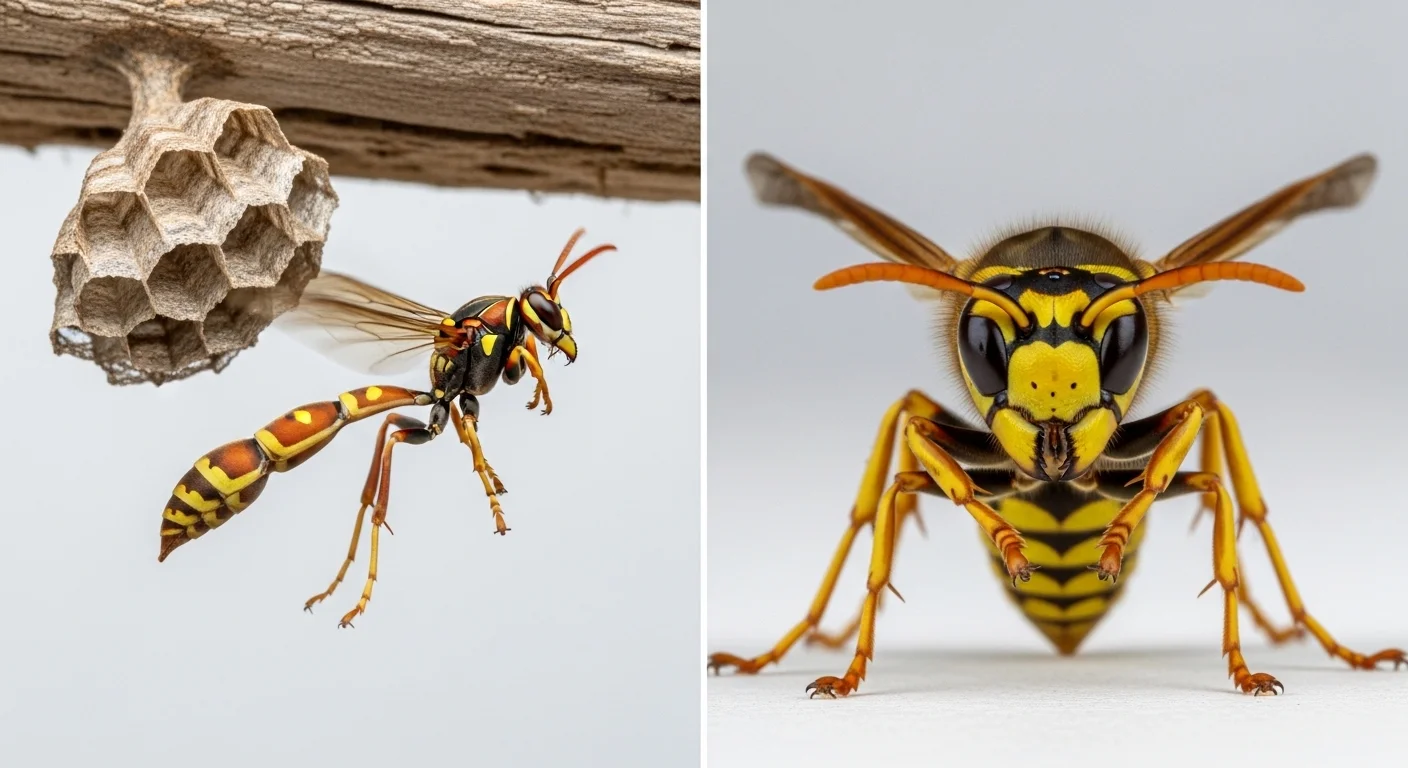
Every summer in Summit County, homeowners encounter a yellow-and-black stinging insect near their eaves, decks, or garage doors and immediately call it a "yellow jacket." But a closer look often reveals a paper wasp — a very different creature with very different behavior, nesting habits, and threat level. Misidentifying the two can lead you to react the wrong way, make the problem worse, or miss a genuinely dangerous situation under your porch.
Both insects belong to the same family (Vespidae) and both sting, but that's roughly where the similarities end. One is relatively docile and can actually benefit your garden; the other is notoriously aggressive, can sting repeatedly, and frequently builds concealed nests that people stumble into without warning. Knowing which one you're dealing with changes everything about how you should respond.
In this guide, we'll cover how to identify each species by appearance and behavior, compare their nests, explain their relative danger levels, and help you decide when a nest is something you can monitor — and when it's time to call a professional.
Why the Distinction Matters
The most important reason to tell paper wasps and yellow jackets apart is safety. Yellow jackets are responsible for the vast majority of serious wasp-sting incidents in the United States. They are highly aggressive defenders of their colonies, will sting without provocation when disturbed, and can sting the same target multiple times. A lawn mower running over a hidden ground nest, a child stepping on a yellow jacket foraging for food, or a homeowner reaching into an infested wall void can result in dozens of stings in seconds.
Paper wasps, by contrast, are comparatively calm. They typically only sting when their nest is directly threatened or when they're physically handled. A paper wasp sitting on your garden railing is unlikely to bother you unless you swat at it.
The distinction also matters for treatment. Yellow jacket nests hidden in wall voids, underground burrows, or attic spaces almost always require professional extermination. Paper wasp nests in accessible locations are sometimes manageable with over-the-counter products — if the colony is small and the nest is reachable safely. Using the wrong approach on the wrong species can provoke a mass-stinging event or scatter a colony into a new location that's even harder to treat.
Key Takeaway
- Paper wasps are docile and rarely sting unless the nest is directly touched or disturbed
- Yellow jackets are aggressive and will sting with minimal provocation, especially in late summer
- Correct identification determines whether you have a nuisance — or an emergency
- Both can trigger anaphylaxis in allergic individuals and should be treated with appropriate caution
Paper Wasps
Paper wasps (Polistes spp.) are the slender, long-legged wasps you commonly see hovering around eaves, door frames, and wooden fences throughout Summit County from late spring through early fall. Despite their intimidating appearance, they are among the least aggressive stinging insects you're likely to encounter.
How to identify them:
- Size: Larger than yellow jackets — typically ¾ to 1 inch long
- Body shape: Slender waist, very long dangling legs visible during flight, elongated abdomen
- Color: Reddish-brown to dark brown with yellow banding; some species appear almost entirely brown. Colors are less vivid than yellow jackets.
- Flight behavior: Slow, deliberate hovering; legs trail visibly beneath the body
- Nest location: Exposed, aerial locations — under eaves, inside door frames, behind shutters, on deck railings
Paper Wasp Nests
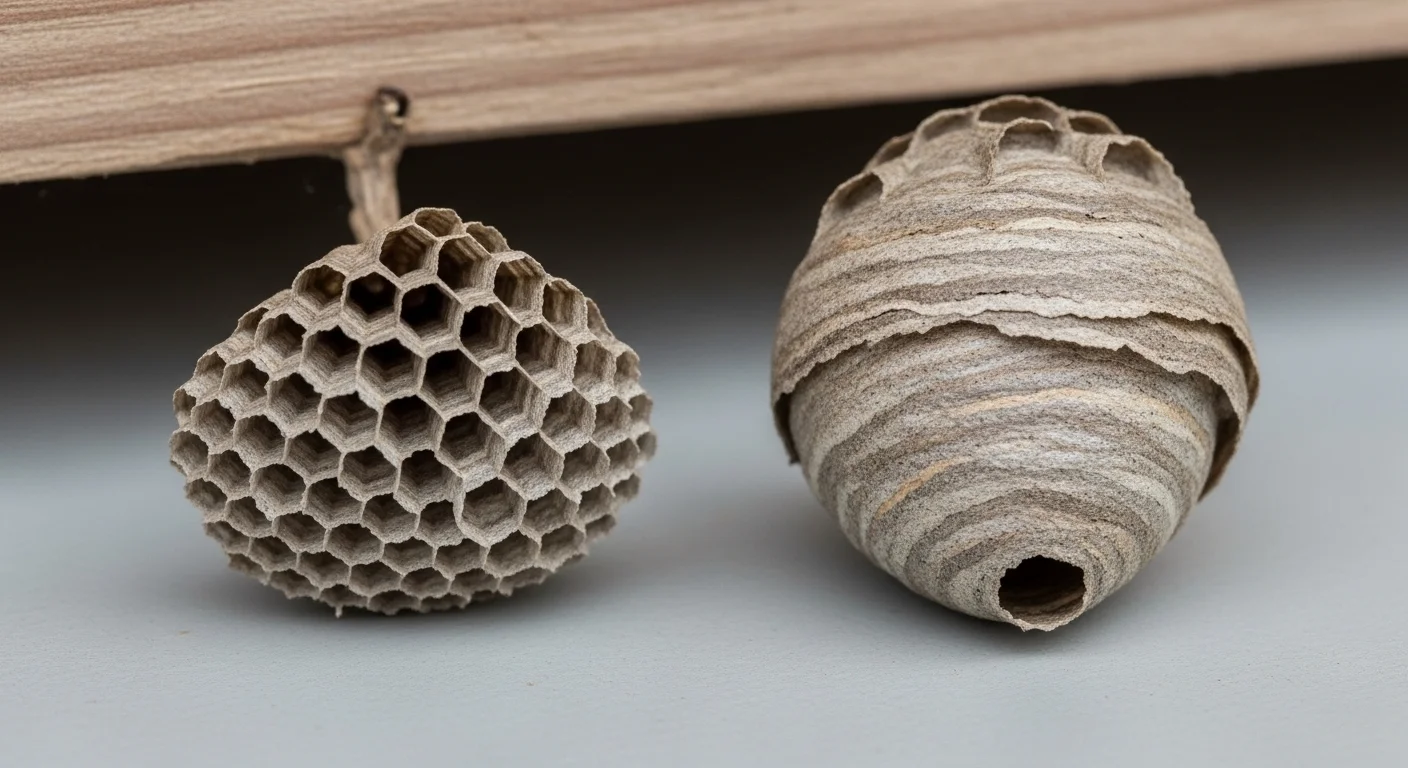
The paper wasp nest is its most distinctive feature. Nests are open-celled, umbrella-shaped structures made from chewed wood fiber mixed with saliva — giving them a papery, gray appearance. The cells are clearly visible from below, resembling a honeycomb. Nests are typically small, from the size of a golf ball in spring to a small dinner plate by late summer. Critically, paper wasp nests are always built in the open. You will never find one inside a wall void or underground.
If you can see the individual open cells of the nest from a distance, it's almost certainly a paper wasp nest. Yellow jacket nests are always enclosed in a papery envelope — you'll never see the combs from the outside.
Paper wasp colonies are relatively small, typically reaching 20 to 75 workers by the end of summer. When weather turns cold in Summit County, workers die off and the nest is abandoned. New queens overwinter in protected spots and start entirely new nests the following spring — they do not reuse old nests.
Paper wasps are also beneficial predators. They hunt caterpillars, flies, and other soft-bodied insects to feed their larvae, which makes them a natural form of garden pest control. A small, out-of-the-way paper wasp nest that poses no risk to foot traffic is often best left alone to complete its seasonal cycle.
Yellow Jackets
Yellow jackets (Vespula and Dolichovespula spp.) are the stinging insects most likely to send someone to the emergency room. They're stockier than paper wasps, intensely yellow and black, and can be found scavenging food at picnics, trash cans, and open soda cans from late summer through fall. In Utah, the Western yellow jacket and the aerial yellow jacket are the most common species.
How to identify them:
- Size: Smaller and stockier than paper wasps — typically ½ to ¾ inch long
- Body shape: Compact, defined waist; legs are not as visibly long or dangling in flight
- Color: Bright, vivid yellow and black banding with little variation. Clean, distinct markings.
- Flight behavior: Fast, direct flight; legs tucked close to the body; frequently hovers near food sources
- Nest location: Underground burrows, wall voids, attic spaces, hollow logs, or inside paper-envelope nests on structures
Yellow Jacket Nests
Yellow jacket nests are enclosed structures with a papery outer shell that conceals the interior combs. The nest entrance is typically a small hole and gives no indication of how large the colony inside might be. Underground yellow jacket colonies can contain thousands to tens of thousands of workers by late summer — far larger than any paper wasp colony.
Never pour gasoline, boiling water, or bleach into a yellow jacket ground nest. These methods are ineffective, dangerous to you, and can contaminate soil. Yellow jacket ground nests in high-traffic areas should always be treated by a licensed professional with appropriate protective equipment.
Yellow jackets are also unique in their food-seeking behavior. Unlike paper wasps, which hunt live prey, yellow jackets are scavengers and are strongly attracted to meat, fish, sugary drinks, and garbage. This is why they swarm picnic tables in August — colony populations peak just as natural protein sources decline, driving workers to seek food wherever they can find it. This late-season foraging also coincides with their highest aggression levels.
Quick ID Comparison
Use this side-by-side reference to make a fast field identification the next time you spot a stinging insect near your Summit County home.
| Feature | Paper Wasp | Yellow Jacket |
|---|---|---|
| Size | ¾ – 1 inch (larger) | ½ – ¾ inch (stockier) |
| Color | Reddish-brown with dull yellow bands | Bright, vivid yellow and black |
| Body shape | Slender waist, long dangling legs | Compact, legs tucked in flight |
| Nest structure | Open-celled, umbrella-shaped | Enclosed, papery envelope |
| Nest location | Always exposed — eaves, door frames | Hidden — ground, walls, attics |
| Colony size | 20 – 75 workers | 1,000 – 15,000+ workers |
| Aggression | Low; sting only when nest threatened | High; sting with minimal provocation |
| Food source | Live insects (caterpillars, flies) | Meat, sugars, garbage, carrion |
| Sting capability | Can sting multiple times | Can sting multiple times |
| Seasonal peak | Spring–summer nest building | Late summer–fall aggression peak |
| DIY-treatable? | Small nests, sometimes | Rarely; professional recommended |
Sting Risk and Allergic Reactions
Both paper wasps and yellow jackets can deliver painful stings and are capable of stinging the same target multiple times — unlike honey bees, which die after a single sting. For most people, a sting produces localized pain, swelling, and redness that resolves within a few hours. For individuals with venom allergies, however, a single sting can trigger anaphylaxis, a life-threatening allergic reaction requiring immediate epinephrine and emergency medical care.
It's estimated that roughly 1–2% of the population has a venom allergy serious enough to cause anaphylaxis. Many people don't discover this until they've been stung as an adult, since allergy severity can increase with repeated exposures over a lifetime. If you or a family member has ever experienced hives, throat tightening, dizziness, or difficulty breathing after a sting, consult an allergist and always carry a prescribed epinephrine auto-injector near known nest sites.
You can be stung dozens of times over a lifetime with no serious reaction, then suddenly experience anaphylaxis on a subsequent sting. Venom allergies can develop at any age.
In terms of relative risk, yellow jackets account for a disproportionate share of serious stinging incidents. Their large colony sizes, hidden nest locations, and aggressive late-season behavior mean that accidental disturbance is common and the consequences can be severe. Children playing in yards, gardeners working near landscaping, and homeowners mowing lawns are all at elevated risk during August and September in Summit County.
What to Do When You Find a Nest
Your response should be calibrated to the species, nest size, and location — not a blanket reaction to anything that looks like a wasp.
Paper Wasp Nests
If you've positively identified a paper wasp nest in a low-traffic location — under an eave far from your door, on a fence post away from play areas — the safest course of action is often to leave it alone and let the colony complete its seasonal cycle. By October, the nest will be abandoned and will not be reused.
If the nest is in a high-traffic area (directly above a doorway, near a play structure, or at face height on a deck), treatment is warranted. A small nest with fewer than 10 visible wasps can be treated at dusk using a wasp freeze aerosol directed at the nest from a safe distance. Wear long sleeves, eye protection, and have a clear retreat path. If the nest is large or in an awkward location, professional treatment is the safer option.
Yellow Jacket Nests
Yellow jacket nests in exposed, accessible locations — a small aerial nest on a shed, for example — can sometimes be treated at night with commercial wasp spray, but this should only be attempted if you are certain no one in the household is venom-allergic and the nest is small. Treat after dark when foragers have returned and activity is minimal.
Ground nests, wall void nests, and any nest you suspect is large should always be referred to a licensed pest control professional. These situations carry the highest risk of mass-stinging events and require appropriate protective equipment and products that aren't available over the counter.
Mark a suspected yellow jacket ground nest entrance with a small flag or rock during the day so you can locate it precisely after dark for treatment. Never approach a ground nest when activity is high. Foragers return to the nest at dusk, making nighttime the safest treatment window.
When to Call a Professional
Some wasp situations genuinely require professional intervention. Attempting DIY removal on the wrong nest can result in serious injury. Call a licensed pest control technician in Summit County if any of the following apply:
- You've found or suspect a yellow jacket ground nest in a yard, garden bed, or near a structure foundation
- Wasps are emerging from gaps in your home's siding, soffits, or around windows — indicating a wall void nest
- The nest is in an attic, crawl space, or enclosed area you cannot safely access
- Anyone in the household has a known venom allergy
- The nest is large (basketball-sized or larger), regardless of species
- You attempted a DIY treatment and the colony is still active
- Children or pets have been stung in the yard and you cannot locate the nest source
A professional technician will identify the species, locate all active nests (there may be more than one), apply the appropriate treatment for the conditions, and verify elimination. For yellow jacket wall void nests, this may also involve sealing entry points to prevent other insects from colonizing the same void.
Frequently Asked Questions